
GHK-Cu for Skin and Hair: What the Research Shows
Compounding pharmacies prepare it for individual prescriptions when practitioners judge potential benefits outweigh theoretical risks.
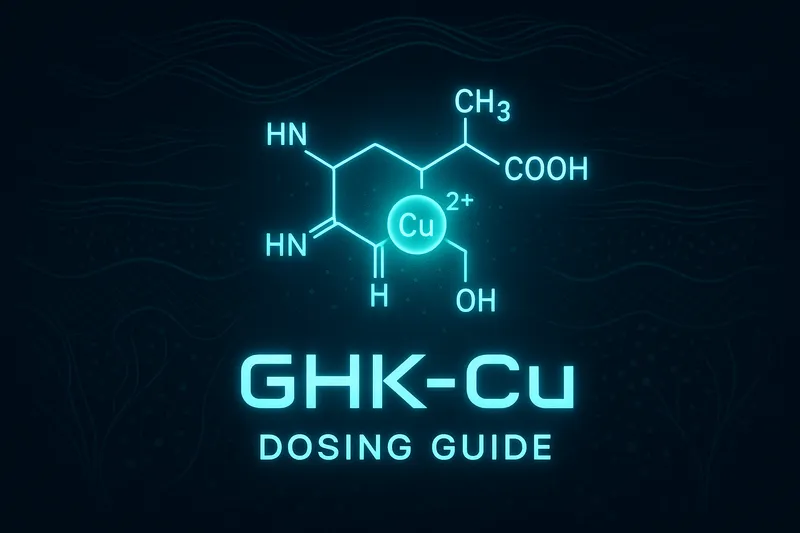
Anyone with known copper metabolism issues should consult physicians before using copper peptides in any form. The body efficiently regulates copper through hepatic metabolism and biliary excretion.
The free Protocol Builder maps the pathways a compound works on and shows what complements it for your goal — built from the same database as this library. Topical use is the most studied and longest-used route, particularly for skin quality and wound healing. Copper peptides are common cosmetic ingredients, and injectable GHK-Cu is due for FDA advisory committee review before the end of February 2027.
In one study, women with telogen effluvium had higher levels of TGF-beta-1 in their scalp, suggesting that it also plays a role in hair shedding unrelated to pattern hair loss. Put simply (an increase in male hormone activity can increase TGF-beta-1), and TGF-beta-1 can tell hair-producing cells to slow down. That increase reduced the growth of nearby hair-producing cells, called keratinocytes, by roughly half.
GHK-Cu is a water-loving molecule (and the outer layer of skin exists to keep those out), so how much of a topical product reaches the dermis is the central question. Scalp serums are formulations (usually containing several actives), and copper peptides rarely appear on their own in real-world use alongside other products and treatments. GHK-Cu A cosmetic ingredient with a credible mechanism, laboratory and preclinical support, and limited human data. No adequately powered head-to-head study has shown copper peptides matching either. There is small-scale human work reporting increased hair density over twelve weeks (but it is limited), short, and has not been independently replicated at scale. What does not exist is a large, properly controlled human trial showing that copper peptides regrow hair.
By modulating pathways at play in growth and cell-based upkeep. This modulation likely occurs through direct effects on dermal papilla cells, which control the growth of the follicle. Alopecia trials for other agents commonly run 16 to 24 weeks minimum to detect meaningful changes in hair counts, using standardized phototrichogram or validated photographic scoring with a placebo arm and blinded assessors. Copper is essential but not harmless at excess doses, and the body has limited ways to excrete it once absorbed. That uncertainty applies to facial and body skin studies generally; nobody has published scalp-specific penetration data for GHK-Cu.

Utilizing the Connectivity Map (CMap)—a comprehensive database created by MIT and Harvard—the impact of GHK-Cu on human gene expression was investigated by the authors, who examined how compounds modify gene activity. This piece serves as a straightforward overview of a peer-reviewed scientific review. While your body synthesizes GHK-Cu naturally, its levels decrease by 60% from age 20 to age 60, dropping from 200 ng/mL to 80 ng/mL. Backed by published clinical studies, copper peptides and micro-infusion are highlighted. A supplier of research peptides provides product pages rich in citations (transparently reporting the published findings), including the adverse results. Classified as a cosmetic ingredient instead of a pharmaceutical, the peptide is typically evaluated in complete formulations rather than as isolated components compared to placebo.
For researchers interested in how other peptides have been studied in tissue repair contexts — the Peptide Register has covered BPC-157’s research profile and Thymosin Beta-4’s wound healing evidence. A double-blind trial published in Aesthetic Surgery Journal (2015) compared a GHK-Cu-containing cream to vitamin C and retinoic acid creams in 71 women over 12 weeks. In animal models, GHK-Cu has been reported to accelerate wound closure, increase angiogenesis, and enhance collagen deposition. GHK-Cu has been studied in the context of wound healing and skin repair, with several lines of evidence at varying quality levels.
Why people apply copper peptides to the scalp
GHK-Cu (a natural copper-bound peptide found in human blood), is primarily investigated for its roles in skin remodeling, collagen synthesis, wound healing, and hair. Our comprehensive guide on GHK-Cu includes benefits and dosage information (addressing systemic effects), injection protocols, and extensive research beyond just skin and hair. The supporting evidence for GHK-Cu stands out as particularly robust for a cosmetic component.
It has the potential to enhance other methods, providing wider-ranging advantages. The use of injections is less thoroughly researched, and prolonged high-dose administration raises concerns regarding copper balance. A 2025 review analyzed both the attractiveness and complications associated with topical GHK, while a different paper from the same year questioned the reliability of current analytical techniques in measuring the permeation of liposome-encapsulated GHK-Cu. An article detailing GHK-Cu and collagen synthesis compiles mechanistic treatments of these pathways, alongside a longer explanation regarding the proposed mechanisms of collagen production. Generally (follicular research utilizing GHK-Cu and related copper tripeptides employs cultured dermal papilla cells), hair-follicle organ culture, or rodent models to study hair cycling.
Risks
The study demonstrated that topically applied peptide-copper complexes could stimulate hair follicle activity, providing the earliest controlled evidence for this application (Trachy et al., 1991). The story of copper peptides and hair begins with animal research in the early 1990s. Multiple studies, including a 2023 microemulsion delivery study in Bioactive Materials, have shown that copper peptide formulations increase beta-catenin expression and activate downstream Wnt signaling targets in mouse skin , Liu et al., 2023,. Understanding these pathways helps contextualize the clinical findings discussed later. Researchers have identified at least five mechanisms through which copper peptides could influence hair growth. A closely related molecule, AHK-Cu , L-alanyl-L-histidyl-L-lysine copper,, swaps glycine for alanine and has also been studied for hair-related applications.
Injectable copper peptides have specifically been flagged as safety concerns and are not endorsed for pharmacy compounding. Compound and blend pages, including combinations discussed under the peptide stacks overview — are educational catalog references, not medical authorizations to use these substances for hair loss. For injectables specifically (U.S. compounding oversight has treated injectable copper peptides as substances of safety concern that are not endorsed for pharmacy compounding), reinforcing that the injectable hair use is outside any approved framework. A product becomes a drug under federal law, and thus requires FDA approval it does not have — the moment it is marketed with claims to treat, cure, prevent, or alter the structure or function of the body.
In a 2006 randomized trial of topical copper tripeptide after CO2 laser resurfacing, 13 patients completed follow-up. Knowing which benefit rests on which kind of evidence is what separates a useful protocol from a hopeful one, and that is the lens this guide applies. Understanding how GHK-Cu behaves in the body affects how you dose and time applications. GHK-Cu copper peptides show genuine promise for supporting hair growth through multiple complementary biological pathways.